
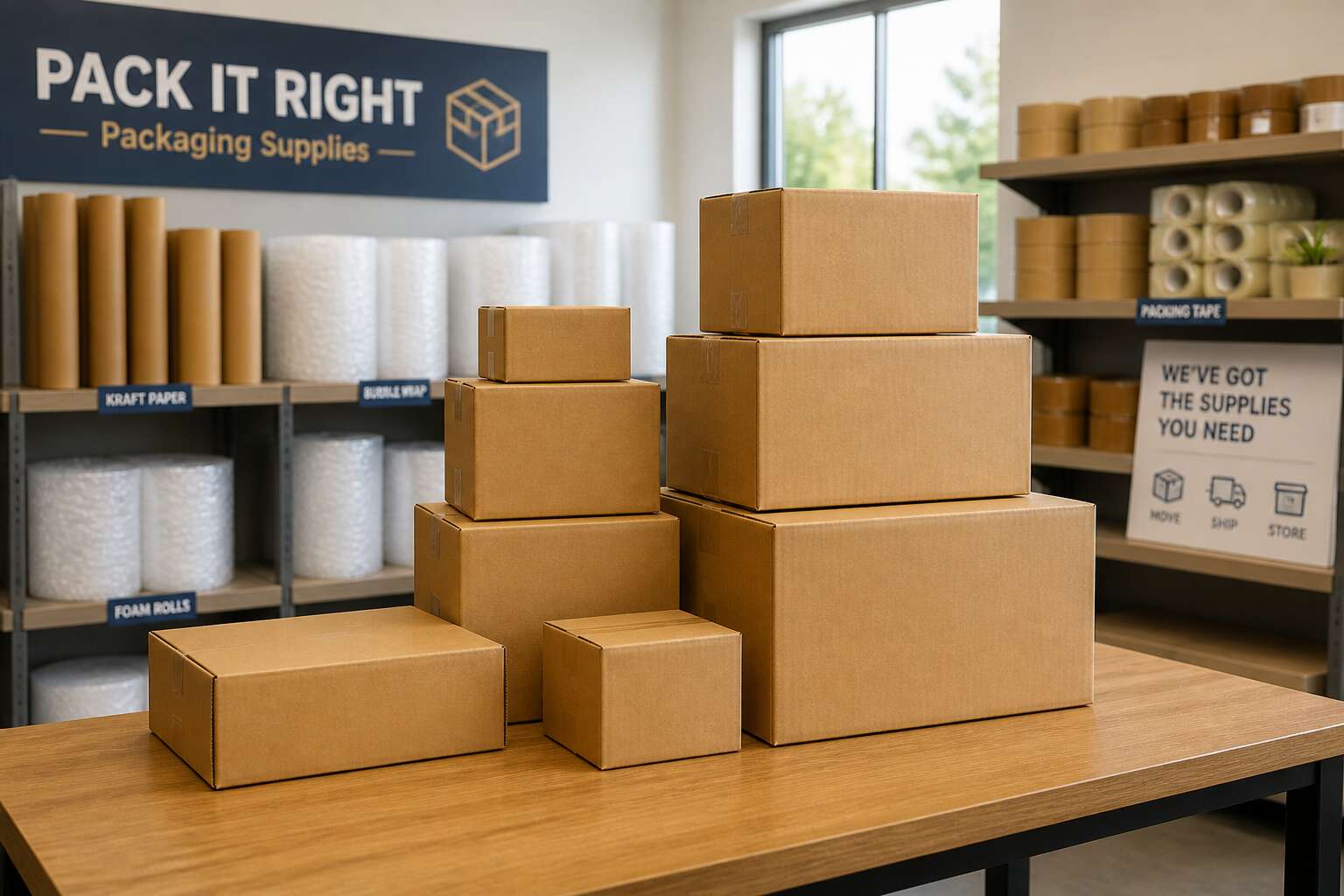
Identifying Your Packaging Requirements
Analyzing Product Shape and Protection Needs
The most fragile items in your inventory deserve more than a generic box. A delicate ceramic vase and a solid steel component demand entirely different packaging strategies, even if their dimensions are similar. Your product’s shape dictates the internal structure required to immobilise it during transit, preventing movement that leads to breakage.
Start by measuring the product’s longest dimension and its weight. A heavy item needs a box with superior crush resistance and reinforced corners. A lightweight, oddly shaped product might require custom foam inserts or moulded pulp to cradle it securely. When you search for packaging places near me, inquire about the specific grade of corrugated cardboard they stock, as single wall versus double wall makes a substantial difference.
Assess the fragility of your product honestly. A ceramic mug needs cushioning on all six sides, while a book only needs protection at its corners. Consider the journey ahead. Will your parcel endure stacking in a delivery truck or rough handling at a sorting facility? Evaluating these variables before you engage a supplier ensures you purchase the correct materials, saving money and reducing product damage in the long run.
Estimating Volume and Order Frequency
Once you know what your product needs, you face the next question: how much packaging should you buy at once? This is where many small businesses make mistakes. They either overorder and waste money, or underorder and pay express delivery fees.
Estimating your monthly volume starts with honest sales forecasts. Look at your order history, seasonal spikes, and upcoming promotions. Multiply that by the number of items per order. That figure tells you your baseline.
- Calculate average orders per week.
- Add a buffer of 20% for unexpected growth.
- Check lead times from your supplier.
When you search for packaging places near me, ask about their bulk pricing tiers and reorder schedules. A supplier with consistent stock levels beats one offering a slight discount but frequent backorders. Your storage space also matters. A pallet of boxes saves money only if you can actually store it. Matching your order frequency to your warehouse capacity prevents cash flow problems and clutter.
Setting a Realistic Budget for Materials
A single broken shipment costs more than the packaging you saved. Identifying packaging requirements starts with a complete specification sheet. Measure everything and note the characteristics that affect packaging choices:
- Weight distribution and centre of gravity
- Surface durability against abrasion
- Sensitivity to shifting inside the box
Setting a realistic budget for materials requires a full cost view. When you search for packaging places near me, compare unit prices alongside delivery fees, minimum order quantities, and storage needs. I have learned to calculate the true cost per shipment, and those rands add up faster than owners expect!
Considering Branding and Unboxing Experience
When searching packaging places near me, look beyond the cardboard. The unboxing experience shapes the first physical impression a customer has of your brand. I have watched orders fail over flimsy presentation, and I have seen repeat purchases earned by a single thoughtful opening. Consider what the customer touches:
- print sharpness and colour accuracy
- the sturdiness of the closure system
- how the product sits inside the void
That attention builds quiet loyalty! In South Africa, where courier distances stretch long, the box arrives before your customer reads a single word. A customer who feels considered in the opening moment often becomes a customer who returns.
Effective Strategies to Find Suppliers Nearby
Exploring Industry-Specific Directories
Searching for packaging places near me often produces endless lists of irrelevant warehouses. My hunt for corrugated boxes in Johannesburg taught me that the best suppliers rarely appear on the first page of results. I found them through industry-specific directories that catalogue manufacturers, wholesalers and converters.
Directories such as the Packaging SA member list organise companies by region and speciality. You can filter for material, then narrow by province. This saves hours of phone calls! Look beyond the company name.
- Check years of operation for stability
- Note product ranges for your industry
- Confirm they service your city or town
Then call two or three candidates and ask about lead times. A supplier three streets away may still ship from another province. When you type packaging places near me into a search bar, the best options often appear inside these specialised lists.
Tapping into Community Recommendations
Your neighbour’s uncle’s cousin might be the packaging oracle you never asked for. Community recommendations often outperform search algorithms, especially when you need packaging places near me that actually deliver. Local business forums and WhatsApp groups overflow with real experiences from people burned by flashy websites and late deliveries.
Ask around the right circles and you will hear the same names repeated with urgency. A quick post in a local entrepreneur group surfaces three or four suppliers nobody else mentions. The comments usually cover the essentials:
- Delivery times that stretched into the next century
- Pricing that mysteriously changed after the first quote
- Damaged goods policies that vanished upon request
These conversations reveal more than any online review ever will. When you search for packaging places near me later, you will already know which names deserve your call. Community intel turns a blind search into a targeted strike.Your neighbour’s uncle’s cousin might be the packaging oracle you never asked for. Community recommendations often outperform search algorithms, especially when you need packaging places near me that actually deliver. Local business forums and WhatsApp groups overflow with real experiences from people burned by flashy websites and late deliveries.
Ask around the right circles and you will hear the same names repeated with urgency. A quick post in a local entrepreneur group surfaces three or four suppliers nobody else mentions. The comments usually cover the essentials:
Delivery times that stretched into the next century
Pricing that mysteriously changed after the first quote
Damaged goods policies that vanished upon request
These conversations reveal more than any online review ever will. When you search for packaging places near me later, you will already know which names deserve your call. Community intel turns a blind search into a targeted strike.
Visiting Local Trade Shows and Markets
Visiting local trade shows and markets remains one of the most direct ways to find packaging places near me. You see the materials, handle the stock, and speak to the people who run the machines. No website can replicate that. At a market, you can compare corrugated options or biodegradable mailers in minutes. Trade shows in Johannesburg and Cape Town attract suppliers who often skip online advertising entirely. You walk away with business cards and a sense of who answers questions honestly.
If you are new to this, a few practical steps help:
– Carry a sample of your current packaging to compare thickness and durability
– Ask about minimum order quantities before discussing price
– Request a list of local clients to gauge reliability
These events cut through the noise. When you search for packaging places near me later, you will recognise the names you met in person. That makes the follow-up call easier.
Exploring Different Types of Packaging Providers
Retail Supply Stores for Small Quantities
Searching for packaging places near me often reveals a spectrum of supplier personalities. Retail supply stores are the workhorses of this ecosystem, especially for small quantities. They offer a tactile experience that digital catalogues cannot replicate. I can test the rigidity of a box before committing my budget.
These retailers bridge the gap between bulk industrial suppliers and the casual seller. They stock a rotating variety of options that accommodate spontaneous needs. Consider the specific archetypes you might encounter:
- Stationery shops carrying basic shipping boxes and bubble wrap.
- Dedicated packaging boutiques offering specialist void-fill and mailers.
- Cash-and-carry wholesalers with a small overstock retail section.
Each category of retail provider offers a different degree of flexibility and pricing structure. The local stationery shop might charge a premium per unit, while the wholesaler offers a slight discount for buying a carton. Your choice hinges on prioritizing immediate access or marginal cost savings.
Wholesale Distributors for Bulk Orders
When your orders grow heavy and the shelf of small supplies thins, the search for packaging places near me takes a turn into the industrial quarter. Wholesale distributors sit on the edges of town, behind chain-link fences and rolling steel doors. I have walked their concrete floors, where boxes stack to the rafters and the air smells of cardboard dust. These providers do not smile at a single unit purchase. They sell by the pallet, by the thousand, by the truckload. Minimum order quantities rule their counters. Discounts appear only when you match their numbers.
- Box manufacturers who supply direct from the production line.
- General packaging wholesalers with broad catalogues of supplies.
- Specialist distributors for fragile, hazardous, or temperature sensitive goods.
Their pricing rewards volume, and that reward is substantial! A single pallet of corrugated cases costs far less per unit than anything from a retail shelf. The tradeoff is your own storage space and cash flow. You must measure your warehouse before crossing their thresholds.
Custom Packaging Companies for Unique Designs
“A box is not just a box,” a packaging engineer once told me, “it is the first handshake your customer feels.” When your search for packaging places near me leads you away from the uniform stacks of retail and wholesale, you enter the quieter realm of the custom shop. These facilities are often tucked into industrial parks, their storefronts unremarkable, but their workspaces hum with die-cutters and inkjet presses. Here, the conversation shifts from unit price to sheer possibility. A custom packaging company does not merely contain your product; they begin to define it.
These providers thrive on unique designs, whether that means a corrugated mailer with a tear-away strip or a rigid box lined with a specific textile. They translate your brand’s idiosyncrasies into tangible materials. You do not shop here for stock; you commission a piece. The process is slower than a retail run, and the cost is higher, but the result creates a tactile impression that a plain brown carton cannot match.
Typically, these operations offer a specific set of services:
– Structural design and prototyping for fragile or awkwardly shaped items.
– Custom print finishes, including foil stamping and spot UV for shelf appeal.
– Short-run digital printing for limited edition or seasonal packaging.
– Sourcing of sustainable or specialized substrates, such as bamboo pulp or bagasse.
Walking into one of these spaces, you often meet the person who will actually build your die line, not a faceless order taker. They ask about your product’s weight, its unboxing moment, and your storage constraints. Many also handle kitting and assembly, which saves you from hiring extra hands. For businesses in South Africa looking to stand out in a crowded market, these packaging places near me offer a direct line to a package that speaks before a word is read.
Sustainable and Eco-Friendly Suppliers
Your gran recycled before it was trendy, but today’s eco packaging suppliers have turned thrift into a science. These operations focus on materials that return to the earth without a court order. When you search for packaging places near me with a green conscience, you find providers offering:
– Compostable mailers that break down in home bins
– Recycled corrugate with high post-consumer content
– Plant-based inks that skip the petroleum parade
They test for durability because nobody wants a box that dissolves in the Joburg humidity. Many also run take-back schemes where they collect used packaging for reprocessing. The cost sits slightly above standard options, but the marketing value is tangible. For South African brands, this is a practical way to align operations with customer values.
Specialized Packaging for Fragile Goods
One broken parcel costs more than the replacement. It costs trust. Specialized packaging providers for fragile goods understand this, so they offer engineering, not guesswork. When you search packaging places near me, look for suppliers who test drop heights and vibration stress.
- Custom foam inserts that cradle every contour.
- Double wall cartons with reinforced corners.
- Cushioning materials like air pillows and honeycomb paper.
These providers also manage logistics for temperature sensitive items. A supplier in Durban might use desiccants for humidity control. Some even offer shock indicators that change colour if a box is mishandled. The cost reflects the protection, but the alternative is worse. Choose a specialist who treats your fragile goods like cargo, not clutter.
Key Factors to Evaluate When Choosing a Local Supplier
Comparing Price Structures and Hidden Fees
Selecting from the packaging places near me involves more than comparing brochures. The supplier’s physical distance influences delivery times and emergency stock availability. A nearby partner can respond quickly when production hiccups occur, while a distant warehouse leaves you waiting.
Price structures demand scrutiny. The quoted unit price often excludes transport, tooling, or handling charges. Some suppliers add a pallet fee, others charge for shrink wrapping. I have watched businesses celebrate a low quote, only to face an invoice with incidental costs. Ask each candidate for a written breakdown before committing. Compare these elements:
- Delivery minimums and fuel surcharges
- Setup or die costs for custom sizes
- Restocking fees on overordered items
- Payment terms that affect cash flow
This comparison reveals the true cost of doing business. The local supplier who quotes transparently often proves cheaper than the distant one with hidden extras.
Reviewing Product Quality and Material Durability
Quality reveals itself in the details. When I visit packaging places near me, I run a fingernail across the cardboard edge. Cheap fluting crumbles. Durable board resists. This small test tells you more than any brochure.
Material durability matters most for products that travel. A box that looks fine in the showroom might buckle under humidity or stacking weight. Ask suppliers about burst strength and basis weight. Request samples and drop-test them yourself. Repeat the process with a second batch.
- Check for consistent print registration
- Inspect crease lines for clean folding
- Test closure strength after repeated use
The suppliers that hesitate to share technical specs are hiding something. A reputable local operation will walk you through their quality checks. Some packaging places near me even offer on-site visits, which lets you verify their claims firsthand.
Evaluating Turnaround Time and Delivery Reliability
Deadlines are where good packaging plans go to die. I have watched orders stall because a supplier quoted two weeks and delivered in five. When I evaluate packaging places near me, I ask for their production calendar, not their sales pitch. A shop with real capacity will give you a delivery date in writing.
Reliability also means honest communication. The best local suppliers call you before delays happen, not after. They keep buffer stock for repeat orders and own their vehicles for critical runs. I check whether packaging places near me actually honor their promises by requesting contact details for long term clients.
I verify their claims with a simple routine:
- Ask for recent delivery records on similarly sized orders
- Check if they offer expedited production for urgent jobs
- Confirm how they handle transport damage claims
These answers separate dependable operations from overbooked ones.
Assessing Minimum Order Flexibility
Minimum order flexibility often reveals the true character of a business. Some packaging places near me demand a thousand units before returning a call. Others happily assemble a short run of fifty. I value the latter. A growing business needs to test its products before committing to an inventory.
When I assess local suppliers, I ask about the smallest order size and the largest. Can they grow with me? A supplier who insists on massive quantities carries lower unit costs, but also risk. If my product changes, I am left with boxes that suit a design I no longer sell.
I also enquire about split shipments. Can they deliver part of an order now, and the rest later? Some packaging places near me allow this with no penalty. That flexibility is worth more than a discounted price. I seek suppliers who treat a trial order as a beginning, not a nuisance.
Confirming Local Pickup and Return Policies
When I search for packaging places near me, I always confirm the pickup process before ordering. Local pickup reduces shipping delays, but it only helps if the supplier has a clear return policy. I need to know who owns the risk if the material is damaged on collection. I also ask about deadline extensions and overruns. Some suppliers treat returns as an inconvenience. Others respect that product changes happen.
Here are the essentials I verify:
- Are damaged goods accepted back without restocking fees?
- Can I return unused stock within a defined window?
- Is there a difference between faulty and unwanted returns?
The answers reveal whether the supplier wants a transaction or a relationship. A rigid policy suggests my mistakes will be costly. A flexible one signals confidence in their own work. That confidence is worth more than a small price discount!
Insider Tips for Maximizing Value from Local Sources
Negotiating with Suppliers for Better Rates
The most generous discounts rarely appear on price lists. I have learned this while watching packers in Durban adjust rates based on loyalty and timing. When you engage packaging places near me, ask for their off-peak pricing schedule. Many warehouses offer better rates when their machines sit idle. I once saved 18 percent by shifting an order to a Tuesday morning.
Suppliers appreciate predictability, so share your annual volume estimates openly. That transparency becomes leverage. Patience also matters. Ask for a quote, then wait three days. A follow-up call often yields a revised figure. The quiet rhythm of negotiation, with its pauses and small concessions, mirrors the local market tradition. Value emerges from relationship, not confrontation.
Requesting Samples Before Committing
One sample tells you more than a dozen brochures. When I approached packaging places near me, I learned that most suppliers will send free samples if you ask directly. Do not assume the quote reflects the tactile reality. Request samples for every material you are considering. Then test them with your actual product. Drop the box, squeeze the corners, feel the weight. A supplier who hesitates to provide samples may be hiding something. Use the sample to check print quality and closure strength. Compare two or three options side by side.
- Run the sample through your packing process
- Measure the dimensions against your product
- Note the smell and texture
The sample session reveals what the price list cannot. Trust that hands-on evidence before any commitment.
Timing Purchases to Seasonal Promotions
Timing your procurement around seasonal promotions can stretch your rand further. In South Africa, packaging places near me often run discounts after major retail peaks like Easter and Black Friday, when suppliers clear surplus stock to make space for new lines. I have saved up to 15 percent by scheduling orders for these windows, but you need to know the rhythm of your local market first.
Ask suppliers directly about their slow months. Many will negotiate on price when orders are thin. The key is to plan ahead, since you cannot rely on promotional stock being available at the last minute.
Consider these patterns:
- January and July often bring post-holiday inventory clearances.
- Mid-year promotions align with budget resets for many small businesses.
- End-of-season sales can offer deeper cuts on seasonal packaging materials.
Building your order calendar around these cycles keeps costs predictable without sacrificing quality.


0 Comments