
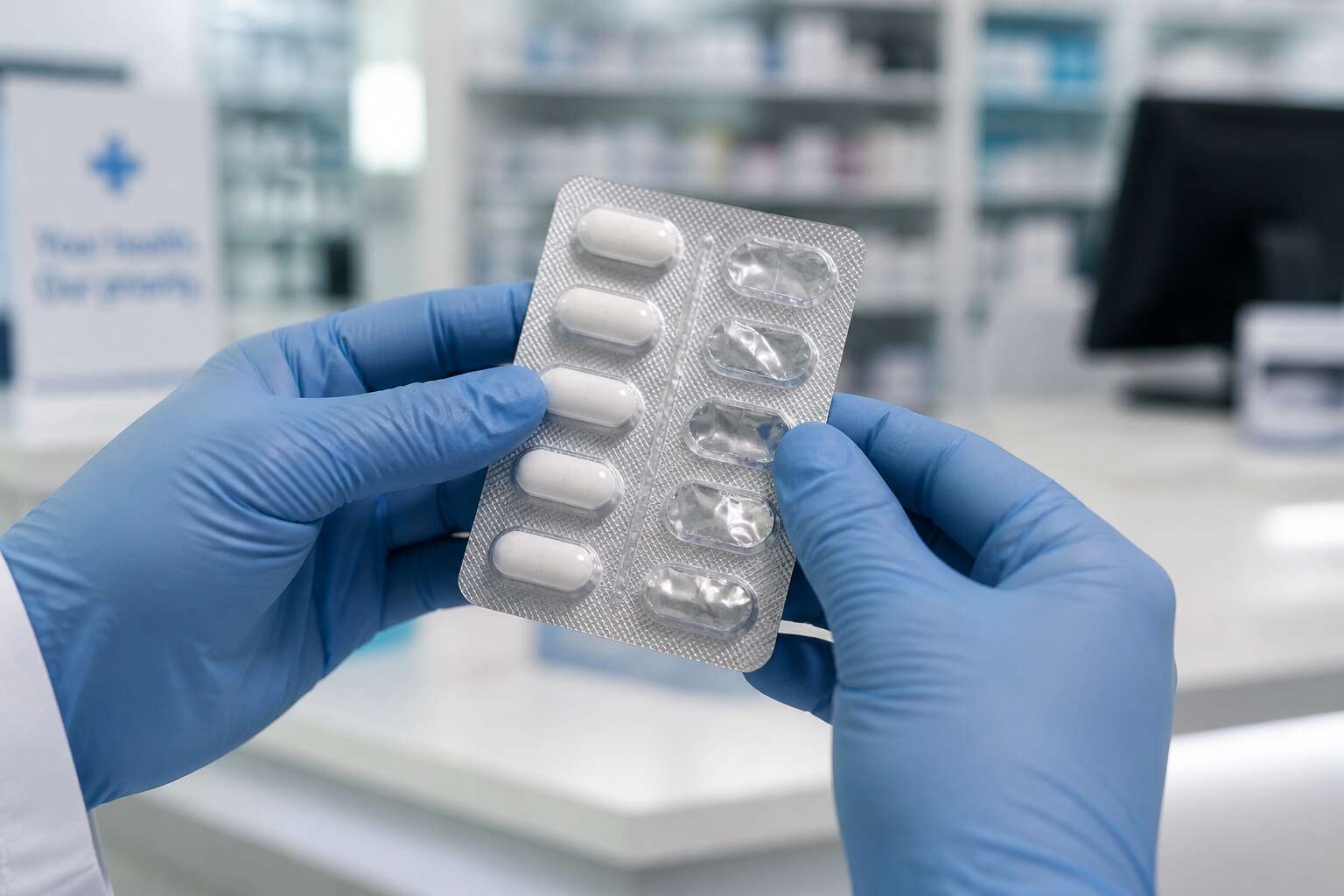
Why Pharmaceutical Blister Packs Dominate Drug Delivery
The Shift from Bottles to Unit-Dose Formats
Half of patients worldwide do not take their medicine correctly, a startling statistic that pushes the industry beyond traditional bottles. Pharmaceutical blister packs deliver something a glass container cannot: individual doses that remain sealed until the exact moment of use. This transition from bulk to unit-dose formats changes every link in the supply chain.
Consider what the shift enables:
– Protection from humidity and oxygen for sensitive compounds
– Clear visual confirmation that a dose has not been tampered with
– Simpler inventory tracking for clinics and hospitals
These advantages matter deeply in South Africa, where climate extremes challenge drug stability. I have watched medical blister packaging reduce pharmacy waste and improve adherence in community settings. It transforms the entire approach to drug delivery, one sealed cavity at a time. That is a genuine improvement for everyone involved.
Enhancing Medication Adherence Through Clear Dosing
Forgetfulness is not a character flaw, it is a design problem. Medical blister packaging solves that problem by turning every dose into a visible obligation. The cavity sits there until you pop it free.
Those printed days of the week across the foil do more than look tidy. They create a daily record that even a tired brain can read. Monday’s empty space means Monday’s pill is gone. No bottle shaking, no counting tablets, no guessing.
Clear dosing brings three practical wins:
- Each popped blister confirms a dose in real time.
- The week layout exposes missed doses at a glance.
- Caregivers can check adherence without interrupting the patient.
In South Africa, where rotating power cuts disrupt routines, a paper and foil calendar never runs out of battery. Medical blister packaging fits that reality with simple, unpowered logic. No charging cables, no app updates, no excuses!
Protection Against Contamination and Environmental Factors
Every unpopped cavity holds its contents in isolation. The foil layers separate the medicine from air, moisture, heat, and curious fingers that might compromise its chemistry. In South Africa, where humidity and load shedding create unpredictable storage conditions, this barrier matters more than we usually admit.
Consider a tablet’s journey. It travels from a factory in Gauteng to a pharmacy shelf in Durban, then into a handbag or kitchen drawer. Each transfer invites contamination. Medical blister packaging intercepts that risk at the point of manufacture, locking each dose in a sterile chamber until the moment of use.
This protection delivers measurable outcomes:
- Moisture ingress is reduced, preserving drug stability.
- Physical handling is minimised, lowering contamination risk.
- Child resistance is built into the push-through design.
The quiet authority of medical blister packaging is easy to overlook. Yet it is the difference between a medicine that works and one that quietly degrades.
Critical Materials and Barrier Properties
Choosing the Right Thermoformable Films
Moisture vapour transmission rate, or MVTR, determines whether a thermoformable film protects its contents. Hygroscopic drugs, those that absorb water from the atmosphere, require films with low permeability. PVC alone provides modest protection. Laminates such as PVC/PVDC or PVC/PE/PVDC block oxygen and humidity, extending shelf life considerably.
South Africa’s coastal regions present a particular challenge. High ambient humidity accelerates the degradation of sensitive compounds, so the film choice becomes as critical as the formulation itself. Cold-formed foil laminates offer the highest barrier, while films using Aclar maintain transparency for visual inspection. The selection matrix considers:
- MVTR and oxygen transmission rates
- Compatibility with the drug’s chemical profile
- Formability and seal strength on existing machinery
For manufacturers of medical blister packaging, these specifications are not abstract lab data. They represent the margin between a stable tablet and a compromised one, between patient trust and product recall.
Aluminum Foil as the Gold Standard for Moisture Barrier
Aluminum foil is the measurement stick for every other barrier material in this industry. Its moisture vapour transmission rate is effectively zero, a figure no polymer membrane can approach. When a drug molecule degrades in the presence of humidity, foil’s dense crystalline structure becomes the final safeguard.
Frankly, I have seen blister lines run for years on PVC alone, but never with the same confidence as foil. The difference shows up clearly in stability studies. South African summers, especially along the coast, expose every weakness in a package design.
- Absolute impermeability to water molecules
- Resistance to pinhole formation under mechanical stress
- Predictable elongation during cold-forming processes
For medical blister packaging, foil delivers the only barrier that never negotiates with the environment. It does not rely on coatings that might crack or delaminate over time.
Specialty Coatings for Light-Sensitive Compounds
Light-sensitive drugs present a different adversary entirely. While foil handles moisture, specialty coatings must block the photolytic degradation that occurs when APIs absorb visible or ultraviolet radiation. The chemistry is unforgiving. A single photon can trigger a cascade that renders a molecule inactive!
I have seen stability failures traced to nothing more than a coating layer applied too thinly. For medical blister packaging, these coatings sit as thin layers over the forming film, absorbing or reflecting specific wavelengths. The challenge is maintaining uniformity across the blister cavity. Thinner areas at the corners of deep-drawn pockets can compromise protection.
Consider the options:
– White opaque coatings that scatter light
– UV absorbers embedded in the lacquer
– Metallic oxide layers that reflect infrared
Each approach carries trade-offs in cost, formability, and compatibility with the drug formulation.
The Role of Child-Resistant and Senior-Friendly Laminates
Each year, South African poison centres field thousands of calls related to accidental paediatric medication ingestion. This statistic underscores a fundamental tension in medical blister packaging. The very features that protect a child from harm, the rigid push-through resistance and tear-resistant laminates, can become formidable obstacles for an elderly patient with arthritis or reduced manual dexterity. The engineering problem is not simply one of strength, but of intelligent compromise.
Child-resistant laminates often rely on a thick, biaxially oriented polyethylene terephthalate layer that requires significant force to rupture. The senior-friendly alternative must achieve the same barrier properties while allowing for a predictable, low-force exit. This is achieved through specialised peel-push designs and precisely scored foil membranes. However, these modifications cannot compromise the integrity of the moisture barrier or invite premature failure.
The hierarchy of compliance is clear, but the human factor remains the weak point in the chain. A package that a grandmother cannot open is a package she will bypass, often by transferring her tablets to a non-compliant container. That transfer negates every protective feature designed into the blister.
Consider the material requirements for this dual mandate:
1. The laminate must resist initial puncture from a child’s bite, yet peel cleanly when an adult applies shearing force.
2. The seal strength must be consistent across varying humidity levels prevalent in Durban and Cape Town.
3. The foil thickness must be sufficient to prevent fatigue cracking during storage, but never so thick as to require excessive force.
The tactile feedback of a correct seal is a sensory cue that patients learn to trust. When the foil gives way with a distinct, audible snap, the user gains confidence. When the force required is miscalculated, confusion and frustration follow. The material science is trending toward thinner, high-tensile foils that offer precise control over this release point. The clear hear-through foil used in some premium medical blister packaging allows for visual confirmation of the tablet, reducing the cognitive load on geriatric users who struggle with tactile identification.
Exploring Blister Pack Designs and Formats
Standard Push-Through Packs: Simplicity and Cost-Effectiveness
Standard push-through packs remain the workhorse of medical blister packaging. Their construction is straightforward: a formed cavity holds the tablet, and a lidding foil breaks when pressure is applied from the reverse side. This simplicity drives significant cost advantages for high-volume generics.
Consider how this format serves clinics across South Africa. Production lines achieve faster cycle times with fewer rejects. Tooling expenses stay modest. The absence of extra layers reduces visual inspection effort.
I appreciate this plainness. It puts the medication first, without added complexity or fragile mechanisms. For essential therapies, that reliability speaks louder than any embellishment. And when procurement teams face tight margins, this unpretentious design keeps essential medicines affordable and accessible.
Peel-Push and Peel-Pull Configurations for Added Safety
Peel-push and peel-pull designs invert the physics of access. Instead of forcing a tablet through a foil, the user first separates a protective layer, then pushes or pulls the medication free. This two-step sequence slows the moment of contact, valuable for medications that require careful handling.
These configurations serve a clear purpose in medical blister packaging. They protect fragile tablets that might crumble under direct pressure. They also accommodate elderly patients whose hand strength has diminished. Peeling demands less force than punching.
Consider where these formats excel:
- High-potency drugs that need controlled release
- Hygroscopic formulations vulnerable to moisture
- Medications dispensed in shared households
I see the trade-off in production cost. Additional layers mean more material and stricter quality checks. Yet for therapies where safety outweighs economy, the peel-push format earns its place.
Cold-Form vs. Thermoform: When to Choose Each
Every packaging engineer eventually faces the question: cold-form or thermoform? The two methods dominate medical blister packaging, but they solve different problems. Cold-form starts with a hard aluminum sheet pressed into shape. It provides a strong moisture barrier. Thermoform uses heated plastic films that stretch into cavities. That makes it faster and more economical.
Consider the material differences:
- Barrier strength: cold-form wins against moisture and oxygen
- Production speed: thermoform runs considerably faster
- Tooling and material cost: thermoform is more economical
Hygroscopic drugs often demand cold-form’s protection. Less sensitive tablets perform well with thermoform. The decision depends on the formulation’s vulnerability and the production budget. In my experience, the budget often decides.
Innovative Multi-Compartment and Chronological Dosing Packs
One in five South African patients struggles to manage multiple daily medications. The standard blister pack, a simple push-through card, hides a deeper vulnerability. For chronic conditions, the challenge is not just swallowing a pill, but remembering which one to take at the right moment. The hidden complexity within modern medical blister packaging lies in its ability to sequence and organise time itself.
Multi-compartment designs are rewriting how we approach complex regimens. These structures combine several cavities on a single card, allowing a patient to navigate a morning, noon, and evening routine with a single glance. They bridge the gap between prescription accuracy and human reality.
– Visual clarity reduces the cognitive load of tracking multiple pills.
– Tactile feedback confirms which dose has been removed.
– Integrated labelling prevents the mixing of look-alike medications.
Chronological blister packs take this concept further by aligning directly with the days of the week. They transform medication administration from a confusing chore into a dated sequence. This format provides a robust safety net for a vulnerable patient and brings welcome reassurance to their caregivers. These tailored formats represent a significant leap forward in safeguarding public health.
Customizable Shapes, Colors, and Branding for Patient Engagement
The blister pack rarely gets a second glance. Yet its shape and colour can determine whether a patient engages with their treatment. In South Africa, where many patients manage multiple prescriptions, visual cues matter. A distinctive hue or a tactile symbol helps identify the right dose without reading a label.
Medical blister packaging now moves beyond the standard white card. We can create rounded cavities, textured surfaces, and bold prints that match a patient’s routine. Branding also matters. A familiar logo or a calm colour palette can ease the moment of administration.
Consider what engages the eye!
- A unique colour for each day of the week.
- A raised icon for evening doses.
- A matte finish that feels secure in the hand.
These choices support adherence. They turn a simple card into a reliable part of daily life.
Regulatory Compliance and Quality Assurance
Meeting FDA and EMA Guidelines for Packaging Integrity
In medical blister packaging, a single compromised seal can nullify months of formulation science. South African manufacturers treat packaging integrity as a measurable outcome, not a bureaucratic checkbox. SAHPRA inspections now mirror FDA and EMA guidelines, demanding evidence from raw material intake to final carton release.
Regulatory compliance for medical blister packaging centres on traceability. Our quality assurance teams record seal force, peel resistance, and moisture vapour transmission rates across every production lot. These parameters are challenged against environmental extremes, from Cape Town humidity to Gauteng dry spells, before a single unit leaves the line.
Audit readiness depends on specific documents:
- Certificates of analysis for every film, foil, and coating batch.
- Validation protocols for each blister tool setup.
- Trending reports from in-line leak detection systems.
- Corrective action logs tied to process deviations.
Under SAHPRA and PIC/S expectations, verifiable data carries more weight than persuasive argument. A pack is only as credible as the evidence trail behind it.
Serialization and Tamper-Evident Features for Counterfeit Protection
Counterfeit medicines siphon off over 20% of South Africa’s pharmaceutical sales each year. Serialization turns every unit of medical blister packaging into a unique data point, traceable from a Durban warehouse to a Pretoria pharmacy. We pair that with tamper-evident features which reveal interference before a patient even breaks the seal.
Quality assurance checks each mechanism:
- 2D data matrix codes for instant batch verification
- Perforated tear lines that fail irreversibly
- Laser-etched microtext on foil backing
The line flags diverted stock within seconds! Every code syncs to a central database, so auditors see the same record as dispatch staff. Tamper evidence stops silent substitution of genuine product for counterfeit. This discipline keeps South African exporters competitive in regulated markets.
Stability Testing and Shelf-Life Validation Requirements
Stability testing forces medical blister packaging to prove itself against time, not promises. A foil cavity that seals impeccably today may fail in month eleven. Our lab drives films through accelerated humidity and temperature cycles that mimic Durban humidity and Highveld dryness, monitoring delamination, colour drift and moisture vapour transmission inside the sealed cavity. The validation sequence covers:
- Blister seal strength across perforated edges
- Polymer and foil adhesion after thermal cycling
- Active ingredient potency at threshold humidity
SAHPRA inspectors expect this shelf-life evidence for every format we ship. When the data contradicts our provisional expiry, we re-engineer the package rather than hide the result. Quality assurance owns that record, and auditors cross-check it against the serialized codes on dispatch. Nobody signs off a stability run without reviewing the print legibility on the backing foil either. This paperwork is the bedrock that keeps South African medical blister packaging credible abroad!
Ensuring Child-Resistance Certification Under ISO 8317
Child resistance certification under ISO 8317 demands more than a click. The test panels include children aged 42 to 51 months, and our medical blister packaging must endure their curiosity for five full minutes. The protocol sets a strict limit on how many can open the pack before approval. We treat each tear, pry and bite mark as data points, not anecdotes.
- Initial child resistance before any instruction
- Senior adult usability after demonstration
- Complete closure after each opening attempt
We recalibrate the test rigs before every batch run. The failure threshold is unforgiving! A pack that passes conventional torque testing can still fail child resistance when laminate stiffness shifts with seasonal humidity. We verify the push-through force curve stays stable across the expiry window. Regulatory compliance comes first. Certification is the proof.
Standards for Elderly Access and Ease of Opening
Nearly 30% of South African adults over 60 admit to skipping a full dose when a blister film will not yield. That refusal becomes the real test. Under SAHPRA, a senior panel trial is required, but enforcement only reflects a number. The medical blister packaging we engineer must carry a certain forgiveness, a controlled release that respects both the formulation and failing motor neurons.
We measure pressure curves across the highveld climate cycles, where seasonal dryness stiffens the plastic. A pack that slides open in March may become a trap by July. Quality assurance validates each opener against a thumb that aches and a stylus on a hand.
The compliance record links force to pragmatism.
- Verify push point at the centre and corners of each cavitated dome
- Measure sealing to ensure it never dips below four newtons
- Confirm tear tabs with moist finger pads, using tempered seniors
We use repeated torque checks and do not rely on instruction, the thumb decides quick. Our medical blister packaging becomes a quiet agreement between design and age, with safety always the final judge.
Validation Processes for Packaging Machinery and Finished Goods
Somewhere between the blister line’s hydraulic sigh and the air-conditioned lab, a different kind of accountancy happens. The packaging machinery is only half the story. The finished goods must survive their own interrogation, a series of trials that strips away assumption and leaves only measured fact. We champion this because a pack that looks perfect still faces the humid ambiguity of a Durban summer or the brutal dry of a Karoo winter.
Validation is a precise ritual. For medical blister packaging, the sealing jaws must be calibrated to a tolerance that feels almost obsessive, yet the entire compliance record depends on it. We measure the dwell time, the temperature gradient, and the pressure distribution across every cavity. The force applied must fall within a tight window. Too low, and the pack is vulnerable. Too high, and the dwell becomes a weak point, a fracture waiting to happen.
The finished goods audit is just as relentless. We test the integrity of the seal itself, ensuring it remains a steadfast barrier against oxygen and moisture. The results get folded back into the process, creating a feedback loop of continuous improvement. And this feedback depends on a strict, non-negotiable protocol:
– Confirm peel force remains consistent after temperature cycling.
– Validate the structural integrity of the lidding foil.
– Assess the coating’s adhesion strength on the print surface.
This data is not merely archived. It is crafted into a narrative of reliability. We map the failure modes, calculate the probabilities, and adjust the parameters of our medical blister packaging until the process yields a predictable article. The true quality assurance lies in this orchestrated consistency. It guarantees the tablet inside remains pure and potent from the moment of sealing to the instant the consumer applies pressure, bridging the gap between industrial machinery and the sacred trust of a single dose.
Sustainability and Future Trends in Drug Packaging
Eco-Friendly Materials: Reducing PVC and Using Recyclable Films
The global conversation around environmental impact has finally reached the pharmacy shelf, challenging manufacturers to rethink their material choices. For South African healthcare providers, the shift toward eco-friendly blister packaging is not merely a trend but a necessary evolution in responsible care. The dominance of PVC, while effective for forming and clarity, presents significant disposal challenges. This has accelerated the search for alternative films that maintain the stringent demands of pharmaceutical protection without compromising recyclability.
The industry is moving toward a more holistic approach that considers the entire lifecycle of the packaging. This evolution is driven by the need to balance protection with planetary responsibility.
– Adoption of polyolefin films that offer a comparable moisture barrier without halogenated materials.
– Use of post-consumer recycled content in secondary packaging layers.
– Development of mono-material structures, which are significantly easier to process in existing recycling streams.
These material innovations are critical, but they must still contend with the reality of product stability. The concept of sustainable pharmaceutical packaging requires that any new substrate provides a barrier that is equal to or better than traditional options. This is particularly vital in a climate like South Africa’s, where humidity and temperature variations can stress the integrity of the medicine inside. The goal is to achieve a lower carbon footprint while ensuring that an aluminium foil laminate remains the preferred choice for maximum moisture barrier protection when the drug demands it.
Looking ahead, the focus is on circularity rather than simple disposal. Recyclable film technology is advancing to a point where it can offer the same optical clarity for visual inspection and mechanical strength for machinery. The final hurdle is the compatibility of these eco-friendly blister packaging options with existing production lines and the local infrastructure for waste collection. It is a logistical puzzle that requires collaboration across the supply chain. The most promising path forward appears to be a strategic blend of reduced material usage and the adoption of renewable feedstocks, ensuring that the future of medical blister packaging is effective and mindful of its ecological footprint.
Lightweighting and Its Impact on Shipping Costs and Carbon Footprint
Lightweighting is the next frontier in pharmaceutical logistics. Reducing the mass of medical blister packaging directly reduces the payload weight on trucks and cargo aircraft. That translates to measurable fuel savings and a diminished carbon footprint per prescription.
We often overlook the logistics behind a pallet of packaged medicine leaving Johannesburg. Every gram of packaging material demands energy to produce, transport, and dispose of. By thinning films strategically and right-sizing cavities, manufacturers cut waste before it ever reaches a shelf.
The impact compounds:
– Lighter shipments allow more doses per delivery.
– Reduced volume lowers cold-chain energy requirements.
– Smaller packaging footprints mean less warehouse space.
These gains do not sacrifice barrier integrity. The shift toward lighter formats is a calculation of efficiency, not a compromise in protection.
Smart Packaging: Connectivity, Sensors, and Digital Adherence Tools
The next evolution of medical blister packaging moves beyond thinner films. We are entering the era of packaging that communicates. Embedded sensors can now track:
- Temperature excursions during transit
- Humidity spikes inside the cavity
- The precise moment a tablet is pushed through its foil backing
This data flows directly to clinicians and caregivers. Connectivity transforms a passive container into an active participant in care. Digital adherence tools use conductive ink traces printed onto the blister itself. When a patient removes a dose, the circuit breaks and registers the event. Providers in Johannesburg or Cape Town can monitor this in real time.
Sustainability and smart features coexist in modern medical blister packaging. Printed electronics replace bulky add-on devices. Sensors add minimal mass, preserving the lightweighting gains. The result is a package that protects the drug, informs the prescriber, and reduces environmental load simultaneously.



0 Comments